
Transcript: Welcome back to the Groth Gets It! podcast. We are live Groth Gets It! podcast. We’re going to explore what it’s like to work in the law practice personal injury law and all kind of things. Regarding running a personal injury practice. So today I’m excited to introduce one of our law clerks, Ava. Ava comes to us from Michigan, kind of roundabout way from out west in Wisconsin. I’ll say it’s west. It’s west of here, theoretically, away from the lake, as we say it. I know that there’s some well, we’ll talk about maybe intellectual law with Ava. Pharmacy stuff, maybe things like that. But before we get into that, we’re going to talk about just Groth law and personal injury law in general and the legal process and, some of the things that she’s learned. And hopefully we’ll get some thoughts on whether Michigan or Ohio is going to win this year. Yeah, I think it’s going to be Michigan.
Michigan. Well, I hope you’d say Michigan. Yeah. Michigan student. . All right. So let’s kick off, this. We start every podcast the way I start my depositions. If you could say your name and spell your name for the record. Ava. Melvin. Ava. Melvin. All right. Good job. You passed. Wow. Okay. So I think we’re going to start this out by. I think Ava is actually interviewing me. I am. Is that. What? Is that true? I think we’re I think you are. Are you aware of this? Sure. Surprise! These are the instructions I was given. Let’s see. Oh, you’re aware of this? Okay. Oh, okay. So you have your own law firm, and you obviously worked at a different law firm before starting your own. Sure. And law firms are businesses on top of being an attorney. So what’s that process like going from just being an attorney to being a business owner and an attorney? What’s the process like? Like eye opening process? Yeah. Because it’s you have a lot more freedom, I’ll say, when you’re simply an attorney in the business.
And now I look back and I totally understand why my previous boss or bosses didn’t have much hair. Maybe why they went prematurely gray. Why they were walking around nervously in the office. And that’s somewhat joking, but somewhat serious, too, is that there’s a lot of stressors that are involved when you run the business. I mean, in the very beginning, it was me in in my basement with our dog, Molly was running overhead. And, at that point we only had two kids. So they’re running overhead, crying and whatever, you know, they’re doing. And I was trying to act like a real lawyer. Talk to clients from the basement. So that that was eye opening, having to manage the practice of law and then the business of law and the business of law being. How do you get new clients? What do you do marketing wise, for that, where do you get paper from? Which vendors can you trust? Because everybody. that, , you talk to says they’re the best vendor, will get you the best deal on let’s say insurance, auto insurance, commercial insurance, whatever else, or, , go to this vendor for paper or that guy for, , business cards or whatever, even though they’re, they’re small things now. But back then, every single penny mattered, right? So it was really stressful trying to figure out, okay, I don’t want to spend money on this when I might need it to advance costs for a client over here, because that’s the other thing is we have to factor in what amount of money, , we have to save to advance for our clients costs. Right? Because when you file a lawsuit, it might cost three hundred bucks. , and you have to serve it. So that’s five hundred dollars. So I have to find five hundred dollars in order to, , advance a case so that someday I’ll get that cost back in addition to fees for my time. So, , that was really the difference and that it was a lot less stressful just working for somebody and then a lot
more stressful being, my own boss. But it did allow me a lot more leeway because I, I didn’t have to be in to work at exactly at eight in the morning. I don’t have to worry about whether my boss is going to give me off off work for vacation or feeling guilty when I took vacation that I wasn’t at work. , so yeah, good question. But, , lots of, it was a big decision doing it, but, , lots of benefits for being your own boss. So you just wanted to be your own boss. Is that what motivated you to start your own firm? , I wanted to be my own boss. So we. , it’s a long story that I’ll tell you off the record. Okay. , exactly what happened. But when you simply ran the numbers at that time. And knowing the referral sources that I had and, you know, at that point I had my own blog. I had started my own, , kind of my own way of marketing myself to other lawyers and other people just over the internet. So I was forward thinking that way, and I kept track of all the clients that I personally brought into the firm. And so I was I was somewhat ahead of the game because I could anticipate what amount of money I would bring into the firm. So it was not too difficult to say, okay, if I look at my track record of bringing in X or Y number of clients, they would settle for A or B amounts. Then I could say, okay, I’m bringing in this amount of revenue to the firm. If I was on my own, this is the overhead, etc. etc. I could probably make a run of it. , so you’re just looking at the kind of the black and white, spreadsheet part of it without emotion. It was a it it was an easy answer to leave. But then once you put emotion into it and the stressors and the not knowing and having two kids, , soon to be one on the way, then it was very stressful to like, okay, well, if we jump in the lake, am I going to be able to swim? Yeah.
Interesting. Now that you run your own business and it’s on its feet, how much is business,man? How much is attorney like, percentage wise? Boy, that’s a good question. I haven’t thought about that. How much is business versus how much is attorney? So today, for example, I, , talked to a few lawyers and met with a client for a while preparing that client for a deposition on Thursday. , if you look at just ours, it’s probably three hours business. Two hours, , lawyering. Okay. , on Thursday, it’s going to be probably the majority lawyering in very little business. , it just depends on any given day. But I think overall, in the past, , six months to a year. Well, even longer than that. But if I look back in the past six months because I don’t have a very good memory past six months, I bet you the vast majority would be business and less would be lawyering. Do you miss just getting to lawyer? Oh, yeah. Oh, totally. I mean, I had a we had an associate who tried a case, , not too long ago, and I was in the just the the Uecker seats. I was in the back just sitting there, , and I was physically, like, vibrating because I, you know, I, I, I knew what questions I would have asked, , I could tell what they were doing. , it was really stressful. And then there was another case more recently that I just remembered that I, , I had a trial scheduled in front of a judge against a certain defense attorney. And I saw that that defense attorney had another trial with a different plaintiff’s attorney, like a month before my trial. So I, , took off a couple of days from work and just sat and watched that trial. And it was it was really cool. . Definitely informative.
Yeah. Well, and you can kind of see what the strategies, you know, what the strategies defense counsel uses, what their technique is, what their mannerisms are and then what the judge kind of thinks, , and what the judge will, will, will tolerate or not tolerate from this particular plaintiff’s lawyer who is not at all organized. And you could just see the judge just like fing because of that. So, you know, just things like that, that would be good helpful hints to make sure that, , we’re doing it the right way and, , kind of get back into the swing of
things. So, yeah. That’s cool. Do you like going into court or does that kind of stress you out? No, I love going to court. If I could go and do, , depositions and trials, I think that that’s what I do for fun. Just for fun? Yeah. Well, yeah, kind of, . That’s good. , like. Well, there is that deposition last week. Did you hear the story about the deposition last week? No, I didn’t, where defense counsel was kind of rude, and I mean, that kind of stuff, I love it. I mean, that’s tons of fun. , and again, that’s something off the record I can talk about, but, , I want to give too many client conferences, but you have to ask other clerks about because Olivia went to that deposition. Okay? So you have to ask her about that deposition. It was very interesting. I was deposing a Milwaukee police officer. . Nice guy. Really a good guy. But his attorneys? Not so much. They were not very pleasant, and they were making objections that were really, , not inappropriate. But we’re not. It didn’t have any basis in the law. It was just a really weird objection. Okay. , so that’s kind of fun to have that give and take. So you kind of like calling out their, like, their BS. Well, yeah. And and it’s fun that I can do that. , now because I’m that older attorney. Okay. Back in the day, it’s like, okay, I’m just some snot nosed kid who, , doesn’t get the respect. But now that I’m on the other side and I. I have more gray hair.
Now, I can, maybe get away with. I have more leeway that, , I, I know what’s supposed to happen, and I, I know the process. I know the procedure. So I can get away with a little bit of The shenanigans out there? Yeah. Okay, cool. How do you evaluate and choose legal tech tools like Filevine? How do I evaluate what? Say it again and choose legal tech tools like Filevine? Yeah. Like what? How did you pick Filevine? Uncertainty leads to inactivity. So I was uncertain about Filevine, so I probably should have got, , involved or should have used it earlier, but there were so many different options that I was looking and looking and looking.
So, , but even that being said, we’re one of the original users of, I want to say top one hundred, but maybe it’s top couple hundred users of Filevine in the nation. Oh, wow. , it was either twenty sixteen or seventeen when we started. , so we’ve been we were certainly an early integrator of filevine. , but back then I looked at I remember having Clio, Yo. I looked at them because Jack Newton is the CEO. He came and spoke to the Wisconsin Bar Association. Solo and small firm meeting. , I remember sitting down with him, talking to him about Clio. I met with the president from Australia, the president of Smokeball, and I think she was from Australia or some. I remember she had an Australian accent. Okay. I met with her about smokeball. There was like, , some, like, Lawdragon or something. Was the name of the company, , practice Panther? , what else did I look at? , like smart advocate needles, all these different companies. And it was just there was just too much information.
So it took me a while to finally make a decision, but, , just the the potential of working in the cloud even back in twenty seventeen and the ability to generate documents with a click of a button was pretty cool that the AI tech well, gosh, well, the AI stuff is now. But yeah, back then, before I was even a possibility. , well, I guess I was a possibility with the LLM aspect of the technology wasn’t really there yet. , or even talked about, , but, , back then having the, the document generation being a kind of a one button process was something that I was used to with this company that we used to use called needles, and then another company that we had called CMS. It was a local programmer who had created this certain, practice management, case management system, CMS. But that was all based on computers. So you had to have a server. Well, when we were going away from servers and we saw the future not being in servers and not having a big computer in our office.
We were trying to look for something in the cloud and have that same technology where you could push a button and then have a docent created. And really, it was there were just a few of the companies out there that did it. And Filevine was probably the best of them. And Filevine came from, a personal injury firm over in Utah. So they knew what we were going through. Yeah. Because of the personal injury side? Correct. Okay. Yeah. Very cool. What drew you to personal injury when you were in law school? And injury? I wanted to I wanted to be a DA, because I wanted to kind of have the the political world where you can run for office and the, , the legal trial world. , and then my criminal law experience wasn’t good. Professor Hammer called me out and that was not a good experience. So I said no to that. And then I wanted to do international law. I studied in Japan for a short bit, through Professor Rosen and, Loyola New Orleans program, and that was awesome. So then I came back here and Professor Waxman at the time, he had a bunch of international law classes. I took those. I don’t speak any other languages. I took Latin in high school. Didn’t really work out. So , I decided not to do that. And then I started taking trial advocacy classes, and I clerked for a personal injury firm in the Chicago area. , and it’s like, oh, well, this is kind of fun, you know? And it you kind of have the show aspect, the political aspect where you’re trying to, convince people to go for your, go for your client. So that was enjoyable. That was a good time. , and just a lot of variety, you know, where you don’t know who you’re going to talk to. , after law school, I worked for, , a small general practice firm. So there were some days when I’d just be drafting a will, , looking over a trust or, like, some kind of buy sell agreement for a business. And that was just the most boring days of my life. And then there were other days when I’d be taking depositions or, I would spend days just in small claims, , trying, you know, trying small claims cases. And that was tons of fun because it was it was really high stress. You don’t know what’s going to happen, but it was exciting. I remember one time I think it was like the day after my birthday or the day of my birthday or something. My boss at the time, the night before, gave me a file and said, get ready for tomorrow, you’re going to go to court with me. And my parents took me out for dinner. Enter. And I just thought I was going to court with him. So I was not prepared. So that next morning he. I meet at the at the office, get in the car, go to I think it was the Waukesha County Courthouse. Go to Waukesha. And he’s like we walk into the courtroom and he’s like, okay, you’re on. I’m like, what do you mean? He’s like, well, it’s a small claims trial. It’s like, well, I’m not ready for the small claims trial. I’m aware, but I just thought you were doing. He’s like, no, you’re going to do it. So, you know, those kind of things where you’re just flying by the seat of your pants? Interesting. That’s fun. That’s when you work the best. I don’t know if I work the best, but it’s the most fun. That’s the most. , it it’s that was high anxiety because I wasn’t prepared. What I usually would do is if I knew I was, like, for all the other small claims trials, I would review the file. , I would get down to court much, much earlier.
Watch everybody else and how they worked and then go up there and then present the case.
But I would almost have a script of what I had to do. , it was less stressful that way, but I was literally a year or months or days or a year out of law school. So I was doing that, , without a lot of help. So it was stressful when I was just thrown in. It was better when I was thrown in, but I had some time to at least prepare myself. Okay. Yeah. Fair. Yeah. Yeah. Good. Okay. Next. Next. These are fun questions. How much time do we have? I have to ask questions now. Oh, my gosh, I’m off the hot seat. This is a whole script we have going here.
I didn’t really ask a lot of the questions off the script, to be honest. Oh, yeah. There’s all kinds of questions we could ask. Let’s see. Okay. Oh, now I’m flip. Now we’re flipping the mic as Olda has written. We’re going to flip the mic. . What surprised you the most about clerking for a law firm? Honestly, I don’t know what I thought. You guys, like, not did all day, but I didn’t. What are you doing? I didn’t know how much you guys talked with the, like the insurance adjusters. I you I mean, I see Brooke like, calling the insurance adjusters all the time, which I guess I don’t know why I thought that it was just like, oh, you send the demand, and then they respond, but it’s like, oh, I need this, or, oh, I need this, or it seems a lot more friendly than I guess I envisioned it to be like a free flow of information. Right. Yeah. And not like, oh, I’m holding this and then I’m gonna not enemies. It’s more like friendly kind of figuring negotiating enemies. Yeah, we still are adverse to each other. Yeah. But, , I think you have to give them information for them to give you what you want, which is money for your client.
Right, right. Yeah. You have to show the proof. Yeah. Interesting. Yeah. And I, I guess I knew that, files take a long time to go through the process, but I guess I didn’t realize how many steps there were to all of the steps of the case. Yeah. You have to get the signature authorization in order to request the medical records. And then half the time, the medical records don’t actually come. And then you have to look at the medical records. And I guess I was thinking that there was a lot more just trust in people and not all of the physical things that you needed and all the steps and all of the hoops you have to jump through. Is it easy to get medical records or not so easy to get medical records? It depends where you’re asking medical records from. I feel like there’s some medical records departments that I would have to call over and over again, and they still haven’t sent them. But then there’s some that’s like, oh, I’ll get it to you. And then they get it to you the next day. And that, I think, is just so surprising that you can have a whole system. Right. It’s it’s you’re really you don’t know how they’re going to react to what I believe is their legal obligation to provide, right, your client’s medical records to the client, and we represent the client. So they should give us the medical records. But it’s like pulling teeth sometimes, right? And sometimes it’s like, okay, but I need this specific date of service. And I know for a fact that there’s this date of service because we have a bill for it.
So then where are the records? And we requested this record four times. And where is it. Yeah. That’s yeah I don’t know. I would think it would be way more organized than it is. Well because they’re, it’s medical records, right. It should be organized. You know, you’re changing your oil in your car. I mean, it’s something that could be life or death for your client, right?
Yeah. , yeah. So. Good. Yeah. That’s interesting. Really interesting. Okay. So you’ve worked on medical records? Yeah. Did you? I know you’re taking phone calls. You were sitting at the reception desk. , you’ve, , worked on demands. Yeah, right, I have, yeah.
Now that you’ve seen all that. What I guess thoughts do you have on how the process works? I don’t, I don’t know. I feel like I don’t know. I think the demands are really interesting because I feel like if we’ve been in communication with the adjusters for so long, I feel like we wouldn’t need to kind of reiterate it. But yet you really do. And you have to lay it out step by step by step, which I guess makes sense, but I don’t know. It’s just a little different. So are you saying it’s just, , step by step more tedious that you think that there would just be? It is really tedious. Yeah. Not in a bad way. Just in a I don’t know. Interesting. Document heavy.
Yeah. Like just all the stereotypes you hear about lawyers. Right. And it’s it’s like, I’m glad I live in a generation of Filevine. Instead of having to hand look through all of these things and hand pull all of them together, which is would be very stressful or. Well, , even before my time. But when I first became a lawyer, we had, , I don’t even know what it would be called now, but it was like a heat paper fax machine. So we would get these faxes that would come in, and they would be, , the paper would roll off the fax machine because it was, like, heated. , so really burned the words onto the paper, and then you’d have to take it. Take the paper because it was it would curl as it came off the fax machine. And you’d have to take it and like, try to, you know, , as you’re straightening a dollar bill, do it the opposite way, get a little, you know, get it. So you could even read it because it would curl up and be really kind of a pain in the tush. But those kind of things where you you would have pages upon pages of that, and then there would be hours where you’re just making copies of those individual facts pages on regular paper, so you could read them easier, you know. So think of all the, , how all the time wasted doing that, right? Yeah. And now the technology has saved time, but it’s also changed it now because things are faster. There’s clients expect more from us and expect it faster with texting and that they want instant responses. Right. Whereas back in the day you could get away with, , sending a fax or it wasn’t really a voluminous fax, it might be a one or two page fax and then sending something in the mail, and you might get it there in two or three days, and they’d respond in two or three days. Yeah. It was much more laid back. Yeah, definitely. Yeah. Yeah. Interesting. It is interesting. All right. So what’s your, , what’s your goal in college? What do you want to do after you graduate? So when I graduate, I am planning to go straight to law school. Okay.
Fingers crossed I get into everything, but I’m planning to go straight to law school. And then afterwards, I kind of hope to work in a firm like a typical firm and then see how I feel about that. Maybe work in-house at a pharmaceutical company or just, I mean, just a company in general. So why a pharmaceutical? I don’t know. I really I really, really like a construction company. I don’t know. I really like chemicals and I really like medicines and drugs and all that stuff. And I think it’s really interesting. And it’s definitely like drug development is definitely becoming bigger and just more present. So I feel like it’s definitely a growing industry that needs a lot of intellectual property help. So I feel like that would be really interesting. Same with like medical instruments. So working with hospitals and stuff like that would also be really interesting. Yeah. I don’t know, , what’s a big. . What’s that? I mean, there’s, like, Abbott down in Chicago, right? . , yeah, like the spine fusion instruments that they put, like the cages in your spine. Yeah, those kind of things. Interesting. So you’d be the attorney helping the inventors or the engineers? Yeah. Make sure that what they’re creating is, theirs. Yeah. Yeah, yeah. Which I think is really interesting. It’s I really, really like science. And so in high school, when I was going into college, I was kind of like, okay, so I really like science. Either that means either research or medicine. And I was like, I don’t really like research that much. So I was like, okay, I’m going into medicine. And then in the past couple years, I years, I realized that I can’t really work well with sick people, and I just wouldn’t be very happy in that role. And so then I was literally Google searching. What can you do with a biology chemistry degree and intellectual property? Patent attorney came up. And so I kind of did some research on that, talked to a different a couple different attorneys about what their day to day life looks like and what they do. And it just kind of called me. Sounds like something I’d be interested in. So it’s science without physically doing the research or the medicine. Less blood and guts. Yes. Yeah. Okay. Yeah. . Let’s see. What else can we ask? What are we on time? Holy cow, we are.
Wow. We are right there at the end of the time already. , okay. , , what do you see? , I guess the future of law as it relates to artificial intelligence. What’s your opinion about AI? Well, let me go back. It’s a terrible question, and I would be a slew of objections if I asked it in a in a deposition. So knowing that, , we use artificial intelligence and llms to some extent here, and knowing that it’s the talk of the town when it comes to, I’m assuming, school and such. Oh, yeah. What what do you, , what do you think about artificial intelligence as it relates to the future of studying? I mean, going to school in a few weeks and then law school, I don’t know. I think that it’s definitely making it easier to not do a lot of work. So, I mean, we have I mean, for my classes, we’ll have homework assignments that are literally, , multiple choice questions that I could copy and paste into ChatGPT. And then they gave me the answer. So it makes that part a lot easier. But it also could be used as a beneficial tool, which one of my teachers was talking about. How you can ask it to create questions for you to study off of for exams. So I also think that’s really interesting, and especially when I’m confused on certain topics, I’ll ask it to explain it to someone who is dumb, like literally explain it to someone who has no idea what’s going on. So I feel like it can be abused and it can get you out of doing a lot of work, a lot of the kind of the grunt work, but I feel like it could also be really helpful. I don’t know, I think it’ll be interesting. It’d be very tricky. Depends on your mindset, right? It depends on what you want to use with it. I mean, you can use you can use a butter knife to butter your bread, or you can use a butter knife to try to break into a McDonald’s. Right? Yeah. There’s a tool that you can use it for good or for evil. , interesting. So do you do you think that, ,you’re getting the proper training on AI, , as a college student that is going to go to law school someday. Do you think you can use AI to your advantage in the future? I think I can, and I think if I didn’t know how to use it, there are classes at school that.
Yeah, which, honestly, I kind of want to take one of them because you can really manipulate it
to do what you want. But I mean, I think there are a lot of resources in the career center and stuff that would be able to help you if you didn’t know how to use it, but I think it can only be helpful if you want it to be, and I think it could obviously be detrimental if you use it that way, but I think it could be really helpful for studying and making it easier to understand big, confusing topics. Yeah. Cool. So you read that book, the Growth Mindset book. What kind of mindset do you think you have? I think I can have both mindsets. I think it depends on the thing. If I really want to understand something, I’ll have a growth mindset. But if I don’t want to understand it, then I’ll definitely have a fixed mindset. I think you have a growth mindset. I think you’re just talking to you. You’re open to so many things and you’re. Yeah. Looking to the. I hope so. I think that’s a good thing. I definitely have a fixed mindset on how I feel about phones. I really, I really hate answering the phone like a lot. I mean, even with my own personal phone, I hate answering the phone. Well, , that’s why you have text messages.
Text messages? Yeah. You have your sibling to say, hey, answer the phone for me, and there’s voicemail to voicemail. Yeah. All right. Let’s see. I don’t think we have much time. Let me ask you one of these scenarios, , scenarios. . Let’s see. A client was injured in a store, but there’s no video footage and only their word. What do you think? What’s your first move as a lawyer, or deciding whether or not to have a client who calls us and say, hey, I was injured in a store. I fell on something. There’s no video footage. What do you what what would you do first? I would go to the store. I would ask them if there’s witnesses. That’s perfect. Yeah, that’s the perfect answer. You have to prove negligence. Yeah? Yeah. Perfect. Yeah. So we,
I think just with that, your summer gets with a plus that you have to get, , witnesses get some kind of other, some other evidence. If there’s no video footage, then you go the old fashioned way and have an affidavit or a written or verbal statement from somebody who is a witness saying, I saw this and I saw this person fall. Yeah, great. Yeah. A+. Look at that. It’s just that easy. . All right. , do you have any advice that you want to give to, . .
Well, I mean, you’ve talked to other lawyers. You’ve looked this up. Any anyone that is interested in. Maybe they’re graduating from high school now, going to college, and they are thinking about being an intellectual property lawyer someday. You’re a couple of years ahead of them. What would you say they should do? I don’t know. Try new things. I mean, be open. Be open to things that you might not expect. Because in high school, I would never would have thought. I would have wanted to have been a lawyer. And my dad was actually mad when I told him I wanted to be a lawyer, not a doctor. So. Yeah. All right. Yeah. So you never know. You never know. One hundred percent. Keep a door open. Oh, one hundred percent. Yeah. , this will be the last question, and then we’ll wrap it up, because now we’re way over time. , tell us something that you, learned that was unexpected or something fun from your time here clerking. Something that I learned that was unexpected. Literally how unorganized the medical records are, and how there are definitely certain hospitals that I wouldn’t go to, really, in the state of Wisconsin. All right.Just by looking at their medical records and dealing with how unorganized they are. Yeah. Yeah. Yeah. , and then some doctors graduate last in their class. Just to warn you. That’s the scary part. Well, some some lawyers graduate last class, too, but. Yeah. Yeah. , and then something fun that I feel like I’ve made a really good connection with all the other clerks. I think they’re all super interesting and have really cool experiences. Good. That was something pleasant. Awesome. Awesome. All right. Well, thank you very much. , it’s been great having you. , it’s sad that it’s like, t minus two days and you’re back to school. , , we’re we’ll keep in touch with where you’re headed next. We’ll, I’ll try to root for Michigan. See if I’m able. Just don’t root for Ohio State I will not. Well, well, I mean, in our household, it’s. Oh, how I hate Ohio State. Okay, good. That’s kind of what we say. . All right, if you’re curious about law school, , what it’s like to be a clerk, , is building a legal career. Please watch some of these podcasts. We have a lot coming up. And this one, I think, was one of the better ones. So, , this is us signing off. Groth gets it!
Groth gets you. Thanks.
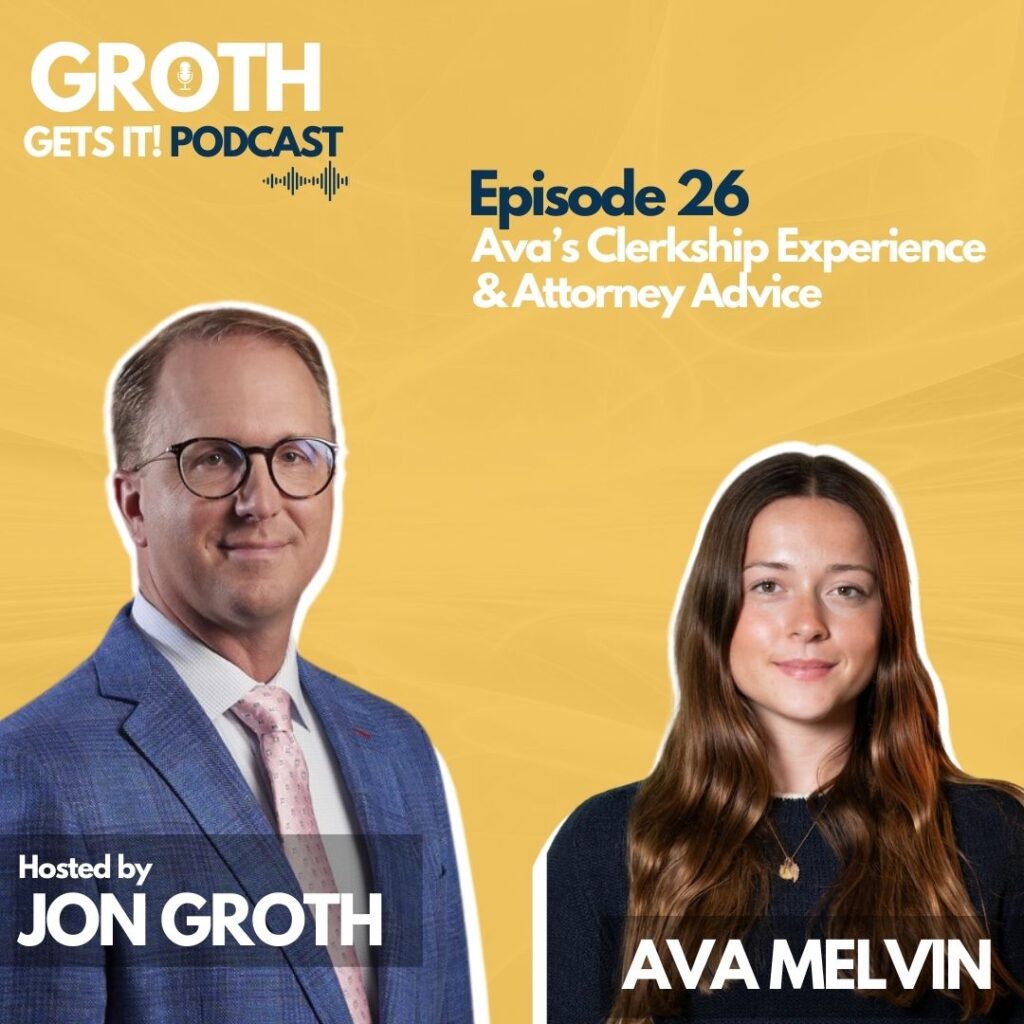
Want to hear the full episode? Click here!